The cheapest foundation repair in Edmond is usually a drain, and it has to come first
Perimeter and yard drainage, downspout extension and regrading — so the clay around your footing stays at one moisture content instead of cycling between swollen and shrunk every year.
Everything else on this site deals with what happens after the ground has moved. This page deals with the thing that moves it. Expansive clay changes volume with moisture content, so the entire mechanism that damages foundations in Edmond comes down to water arriving unevenly and at the wrong times. Control the water and you control a large share of the movement — which is why, on a house with modest symptoms and an obvious drainage fault, we will often recommend a drain and a monitoring period instead of a pier plan, even though it is the smaller invoice.
The faults are mundane and extremely common. Downspouts discharging at the foundation, dumping the runoff from a whole roof plane into the backfill beside your footing — the single most frequent cause of localized movement we see. Negative grading, where the ground falls back toward the house, often because landscaping, a new patio or years of mulch topping-up changed the original falls. Standing water that sits for a day or more after rain in a yard where clay will not drain. Irrigation running against the foundation and keeping one side permanently damp while the other side bakes. Hard surfaces — drives, patios, walks — sloping back toward the wall. And no perimeter drainage at all, which is normal for houses in this area and fine until the lot or the planting changes.
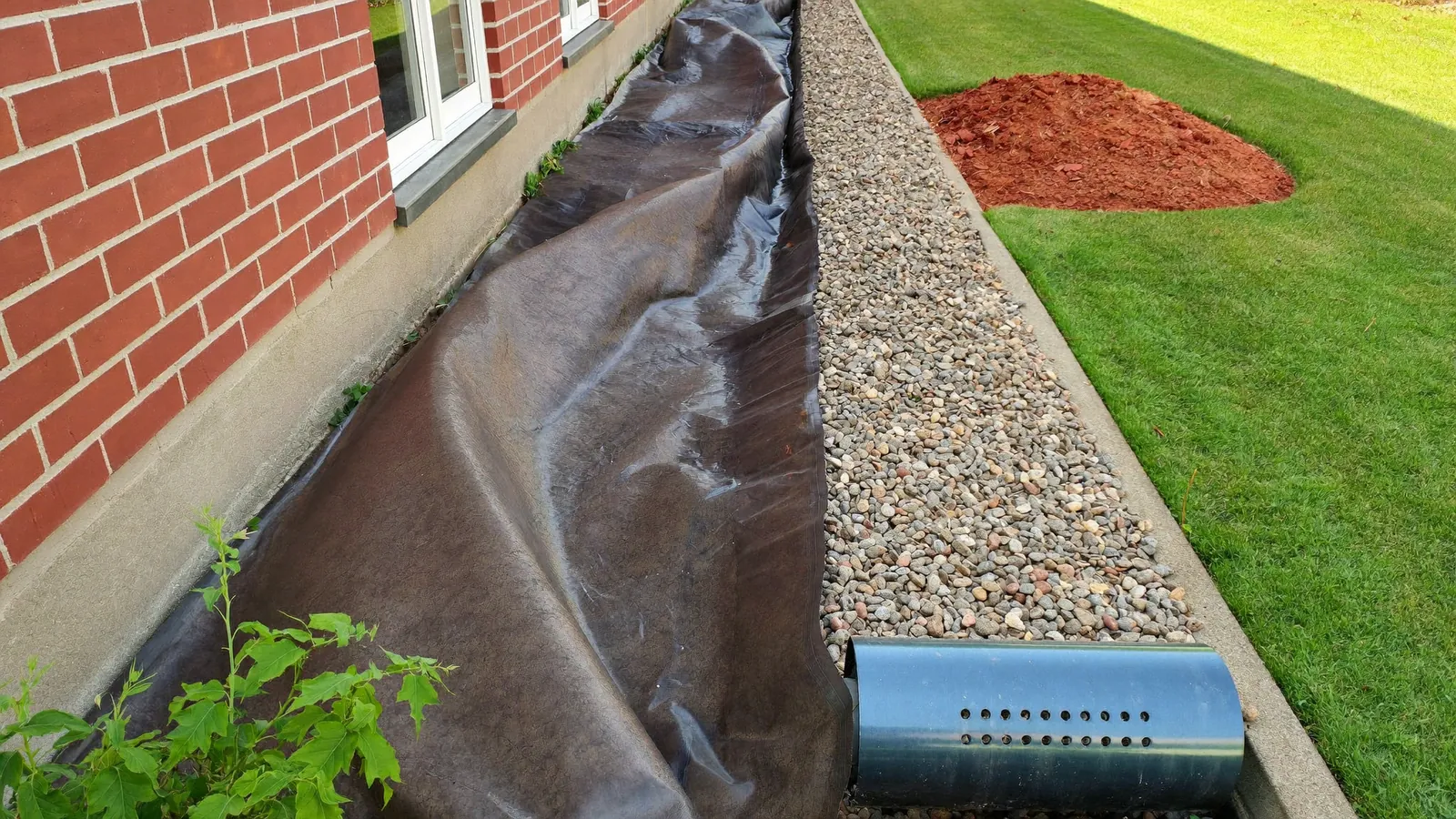
A french drain is the standard remedy and is simpler than the name suggests: a trench, lined with filter fabric, containing perforated pipe bedded in washed gravel, falling to a discharge point. Water in the surrounding soil enters the gravel, finds the pipe and leaves. The fabric keeps fine clay particles out so the stone does not silt up and stop working — and skipping the fabric, or using the wrong aggregate, is why a cheaply built drain fails within a few years. Around a foundation it runs the perimeter and catches water before it reaches the backfill; in a yard it intercepts flow across the lot or drains a low spot that holds water. Discharge matters as much as collection: a drain that carries water fifteen feet and lets it out is still putting it in your soil, just slightly further away.
Alongside that, the cheap work. Downspout extensions taking roof water at least six to ten feet from the house, underground where that is tidier. Regrading to re-establish a fall away from the foundation over the first several feet. Surface drains and catch basins at low points. Irrigation adjustment so sprinklers are not watering your footing. Some of this costs a few hundred dollars. On a house whose movement is being driven by water management, it is the highest-return money in this entire trade, and we would rather sell it to you than a pier package you may not need.
What's included
Water traced before anything is dug
Where it arrives, where it stands, where it runs and where it should go — established on site, because a drain in the wrong place is just a trench.
Perimeter drains built properly
Filter fabric, washed gravel, perforated pipe, and a consistent fall to a real discharge point, so the stone does not silt up and quit.
Yard drains and catch basins
Interception across the lot and collection at low spots where clay will not let water away on its own.
Downspout extension
Roof water taken well clear of the foundation, run underground where that suits the property better.
Regrading at the foundation
A positive fall re-established over the first several feet, undoing years of mulch, landscaping and settled backfill.
Discharge that actually discharges
Water taken to a point where it leaves the site or soaks away harmlessly, not relocated a few feet along the same wall.
French drain installation cost in Edmond, OK
| Item | Typical range | Notes |
|---|---|---|
| Drainage assessment | Free – $350 | Free with most inspections |
| French drain, per linear foot | $25 – $75 | Depth and access dependent |
| Perimeter foundation drain, typical home | $3,000 – $9,000 | Full or partial perimeter |
| Yard drain / low-spot drainage | $1,200 – $4,500 | By area and run |
| Downspout extension, per downspout | $150 – $500 | Underground costs more |
| Catch basin with piped outlet | $400 – $1,200 each | At collection points |
| Regrading at the foundation | $600 – $2,500 | Fill, shaping and finish |
| Complete drainage package | $1,500 – $6,000 | Usually the best first spend |
These are 2026 budgeting bands drawn from published cost guides and what work of this kind runs in the OKC metro. Your figure comes after the elevation survey, itemized by pier, section or linear foot, and the written scope holds for 30 days.
Recent work

Questions we get about french drain installation
Will drainage alone fix my foundation problem?
Sometimes genuinely yes, and we will tell you when we think so. Where the elevation survey shows modest movement and the exterior walk finds a clear water fault — downspouts at the wall, a lot falling back toward the house, irrigation soaking one side — correcting the water and monitoring through a seasonal cycle is the proportionate first step, and a good number of Edmond houses stabilize. Where the survey shows substantial settlement with lost bearing support, drainage will not lift anything and piers are the answer. The survey is what separates the two cases, which is why it comes first.
How far should downspouts discharge from the house?
Six to ten feet as a working minimum, and further if the ground falls slowly or the soil is particularly heavy. The thing worth picturing is the volume: a single downspout on a decent roof plane can deliver hundreds of gallons in one storm, and discharged at the wall every bit of it goes into the backfill beside your footing. Extensions are cheap, can be run underground to a pop-up emitter if surface pipes annoy you, and are probably the highest-value hundred dollars anyone spends on a foundation.
What's the difference between a french drain and a surface drain?
Where the water is when you collect it. A french drain is subsurface: perforated pipe in gravel, collecting water from within the soil, which is what you want around a foundation or in ground that stays saturated. A surface drain is a grate and a solid pipe, collecting water already running across the surface, which is what you want at a low spot that ponds or at the bottom of a sloping drive. Many properties need both, doing different jobs.
Can I install a french drain myself?
Physically yes, and people do. The failures we get called to repair are consistent: no filter fabric, so the gravel silts up with clay fines within a couple of seasons and the drain stops; the wrong stone, so there is not enough void to carry water; insufficient or inconsistent fall, so water sits in the pipe; and a discharge point that just puts the water back into the same soil fifteen feet away. The trench is the easy part. Getting those four right is the job.
How long does installation take?
A downspout extension is an hour or two. A yard drain is usually a day. A full perimeter foundation drain on a typical house is two to four days depending on length, depth, access and what the machine encounters. Heavy clay digs slowly, and we will tell you in advance if your ground or your access is likely to extend the schedule.
Will it damage my yard?
There will be a trench, so yes, temporarily. We keep the run as tight as we can, set spoil on sheeting, backfill and compact properly and reinstate the surface, but a new drain line is visible across a lawn for a season until it knits back in. Where it has to cross planted beds we will discuss the route beforehand. It is honest to say this is disruptive work and not honest to pretend the grass goes back perfectly on day one.