Nearly every Edmond house is a slab, and the slab is only as flat as the clay beneath it
Conventional and post-tension slabs, edge lift and center lift, perimeter and interior piering, and the tendon location work that has to happen before anyone cuts a post-tension floor.
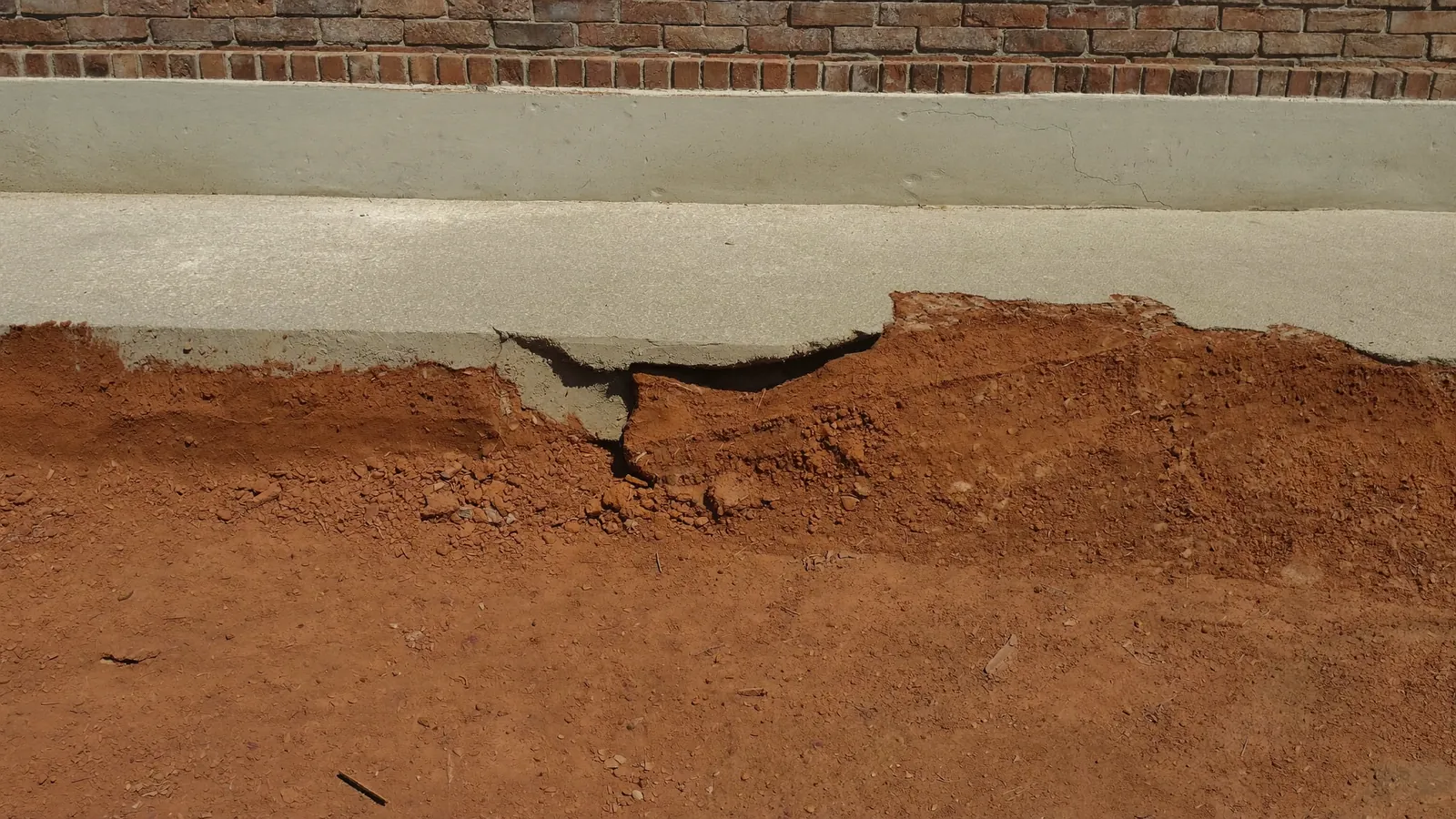
Slab-on-grade is the default here and it is not an accident of taste. Expansive clay and a high water table make basements impractical across the OKC metro, and southern building codes never required footings below a deep frost line, so there was never a structural reason to dig. The result is a city of houses sitting on a concrete raft poured more or less directly on red clay — with a thickened perimeter beam around the edge carrying the walls, and the floor slab spanning between.
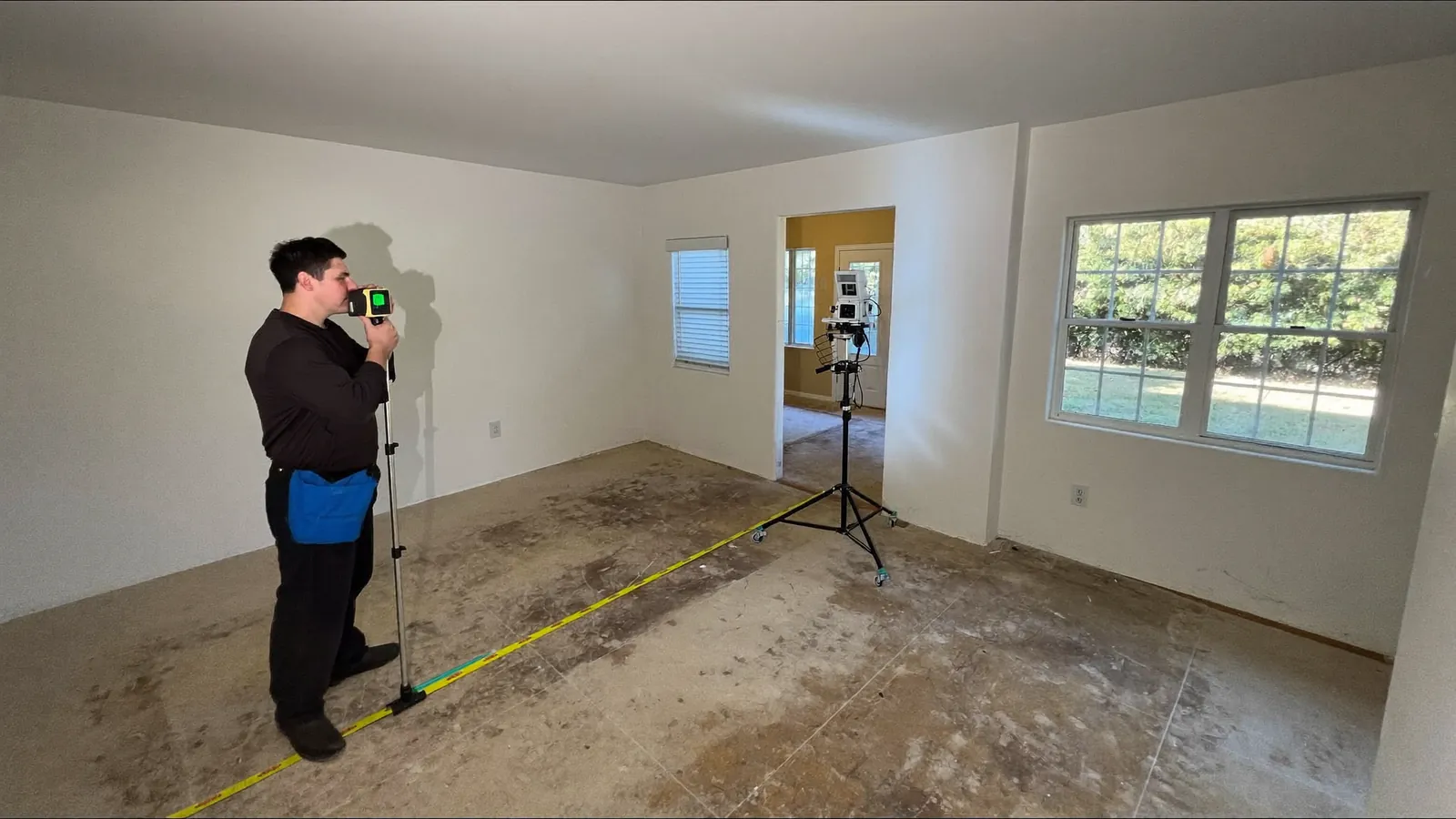
Two broad things go wrong. Settlement is the one people expect: soil shrinks or compresses, the slab loses support, and that part of the house goes down. In Edmond it concentrates at the perimeter, because the edge soil dries fastest in an Oklahoma summer and the perimeter beam is carrying the wall loads. Heave is the opposite and is badly under-diagnosed. Clay that has dried through the summer takes up water rapidly when the rain arrives, swells, and pushes the slab up. Because the soil beneath the middle of a slab stays covered and relatively damp while the exposed perimeter dries hard, you get center lift: a floor domed through the middle. Rain against a house with bad drainage produces the inverse, edge lift, with the perimeter rising relative to the center. Settlement and heave can produce superficially similar cracks, and piering a heaving slab makes things worse rather than better. This is precisely why the elevation survey is not optional — the floor contour distinguishes them and the cracks do not.
There is a second distinction that matters a great deal in the newer parts of Edmond: post-tension slabs. Much of the construction in Deer Creek and the newer subdivisions uses post-tensioned concrete, where steel tendons run through the slab in sheathing and are stressed after the pour, putting the concrete into compression. They perform well on expansive soil. They also mean you cannot cut the floor casually. A tendon under tension that is cut without being de-stressed releases violently; it is a genuine safety matter and a serious repair bill. Before any interior work on a slab we establish the construction type, look for the tell-tale stressing pockets around the perimeter and the builder's tendon plan, and scan to locate tendons before a saw touches concrete. Any contractor willing to open your post-tension floor without doing that is telling you something about how they work.
Repairs follow the diagnosis. Perimeter settlement is usually piers along the affected beam. Interior low points may need piers through the slab, which means cutting and restoring floor sections. Where the driver is clearly moisture management — and in a surprising number of Edmond houses it is — the right first move is drainage correction, downspout extension and regrading, with crack repair afterwards, which costs a fraction of piering and often holds. Heave is a different exercise again: it is about removing the water source and letting the soil return toward equilibrium, not about jacking. If someone has quoted you piers for a domed floor, get a second opinion before you sign.
What's included
Settlement or heave, established first
The floor contour separates a slab that has dropped from one that has lifted — opposite problems with opposite repairs and occasionally similar cracks.
Construction type confirmed
Conventional or post-tension, established from stressing pockets, builder documentation and scanning before any interior work is scoped.
Tendon location before cutting
Post-tension slabs scanned and marked so no stressed tendon is ever cut — a safety requirement, not an optional extra.
Perimeter and interior piering
Piers along the affected grade beam where the perimeter has lost support, and through-slab piers at interior low points where the contour requires it.
Slab sections cut and restored
Openings saw-cut, piers installed, concrete replaced and finished back, with the sequence arranged room by room.
The water dealt with
Drainage, downspouts, grading and irrigation corrected as part of the scope, because a slab repaired over an unchanged moisture problem will move again.
Slab foundation repair cost in Edmond, OK
| Item | Typical range | Notes |
|---|---|---|
| Elevation survey and slab assessment | Free – $350 | Free on most homes locally |
| Post-tension tendon scanning and marking | $300 – $800 | Before any interior cutting |
| Perimeter pier, installed | $1,200 – $2,800 each | Push or helical per conditions |
| Interior pier through slab | $1,500 – $3,500 each | Includes cutting and restoration |
| Slab crack repair, injection | $250 – $1,200 per crack | Epoxy or polyurethane |
| Typical slab job, 6–12 piers | $8,000 – $18,000 | 2,000 sq ft, moderate settlement |
| Full slab replacement | $8,000 – $20,000 | Rare; around $12,000 typical |
| Drainage correction package | $1,500 – $6,000 | Often the better first spend |
These are 2026 budgeting bands drawn from published cost guides and what work of this kind runs in the OKC metro. Your figure comes after the elevation survey, itemized by pier, section or linear foot, and the written scope holds for 30 days.
Recent work

Questions we get about slab foundation repair
How do I know if I have a post-tension slab?
Look at the perimeter of the slab from outside, low down, for small patched circular or rectangular pockets at intervals — those are the stressing pockets where tendons were tensioned and cut off. Inside a garage you can sometimes see them before they are covered. Houses in Edmond built from roughly the 1990s onward, particularly in the newer subdivisions, are commonly post-tensioned, and there is often a plate or stamp in the garage saying so. Your builder documentation or the original plans will confirm it. We check for all of this before scoping anything that involves opening the floor, and we scan to be certain rather than relying on the age of the house.
Can a post-tension slab be repaired?
Yes, routinely. Piering works on post-tension slabs much as it does on conventional ones — most of the work is at the perimeter beam and does not involve cutting the floor at all. Where interior work is genuinely needed, tendons are located and marked, and openings are planned between them. Where a tendon has to be interfered with, it is de-stressed and re-stressed properly by people who do that work. What must never happen is a saw going into a post-tension floor on the assumption it will be fine.
My floor is higher in the middle. Is that settlement?
Probably the opposite, and this is one of the most important distinctions in Oklahoma. A floor domed through the middle usually indicates center lift: the soil under the covered middle of the slab has stayed damp while the exposed perimeter dried hard and contracted through the summer, so the middle is high relative to the edges. The repair for that is removing the moisture differential and letting things equalize, not jacking the perimeter. Piering a heaving slab can make the damage worse. If you have been quoted piers for a domed floor, please get a second opinion first.
Is a cracked slab always a problem?
No. Concrete shrinks as it cures and most slabs develop shrinkage cracking in the first year or two, typically fine, irregular and not associated with any level change. What matters is whether a crack is accompanied by vertical displacement — one side sitting higher than the other — whether it is widening over time, and whether the floor contour shows movement in that area. A crack you can see in the garage floor with no displacement and a flat elevation reading across it is usually a cosmetic matter and sometimes a water-entry matter, not a structural one.
Should I repair the slab or fix the drainage first?
Often the drainage, and we will tell you when that is our honest view even though it is the smaller invoice. If the elevation survey shows modest movement and the exterior walk finds downspouts discharging at the wall, a lot falling back toward the house or irrigation soaking the perimeter, then correcting the water and monitoring through a seasonal cycle is the proportionate first step. It costs a fraction of piering and in a good number of Edmond houses the movement stops. Where the survey shows real settlement with lost bearing support, drainage alone will not fix it and we will say that just as plainly.
Does under-slab plumbing need checking?
If the pattern suggests it, absolutely, and before any piers go in. A leaking supply or sewer line beneath a slab keeps one zone of clay saturated permanently and produces localised movement that looks exactly like soil settlement. The giveaways are a wet or warm spot on the floor, an unexplained rise in the water bill, movement concentrated around kitchens and bathrooms, and a contour anomaly that does not match the drainage picture outside. Piering a house over a live leak means doing the job twice, so where we suspect it we recommend a plumbing test before we quote.